Understanding Autism Symbols: Meaning, History, and How They’re Used Today

Symbols help people communicate ideas quickly and create shared understanding. In the autism community, symbols have long been used to promote awareness, signal support, and encourage conversation. Over time, as understanding of autism has expanded through research, advocacy, and lived experience, the symbols used to represent autism have also evolved.

Today, there is no single image that represents every individual or family. Instead, a variety of symbols are used across schools, clinics, community organizations, and digital spaces. Exploring autism symbol history helps provide context for why different images exist and how they are used today across different settings.

This blog explores the history of autism symbols, the most commonly used imagery today, and best practices for choosing symbols that reflect dignity, inclusion, and respect for individuals with autism and their families.

A Brief History of Autism Symbols

The use of symbols to represent autism developed alongside early public awareness efforts. In the mid-20th century, autism was not widely understood, and outreach focused primarily on education and recognition. During this period, symbols were often used to introduce the public to autism and provide a visual reference point for learning and discussion.

As research advanced and diagnostic criteria became more clearly defined, autism awareness expanded beyond clinical settings. Symbols began appearing in educational materials, fundraising campaigns, and community events. Over time, these visuals became familiar to families, educators, and service providers and played a role in shaping early autism education efforts.

Understanding autism symbol history means recognizing that these images reflect the knowledge, language, and priorities of the time in which they were created. As conversations around autism have continued to grow and change, new symbols and designs have emerged to reflect evolving perspectives on inclusion, accessibility, and quality of life.

A Widely Recognized Autism Awareness Symbol

The puzzle piece is one of the earliest and most widely recognized symbols associated with autism. First introduced in the 1960s, it became closely associated with early autism education and public awareness efforts at a time when understanding of autism was still emerging.

Over the decades, the puzzle piece appeared in informational materials, advocacy campaigns, and community programs, becoming a familiar autism awareness symbol for many families, educators, and service providers. For some, it represents early recognition and the growth of autism-related resources and services.

Today, the puzzle piece continues to appear in certain contexts, often paired with language that emphasizes respect, support, and inclusion. As with any symbol, its meaning is shaped by how it is used, the audience it serves, and the values communicated alongside it.

Key considerations when using autism symbols include:

  • Familiarity: Some imagery is widely recognized and easy to identify
  • Audience: Interpretation may vary depending on community and setting
  • Intent: Symbols are most effective when paired with respectful, person-centered language

Common Autism Symbols Used Today

In addition to historically recognized imagery, many other symbols are commonly used to represent autism and the autism spectrum. These designs often emphasize individuality, diversity, and connection.

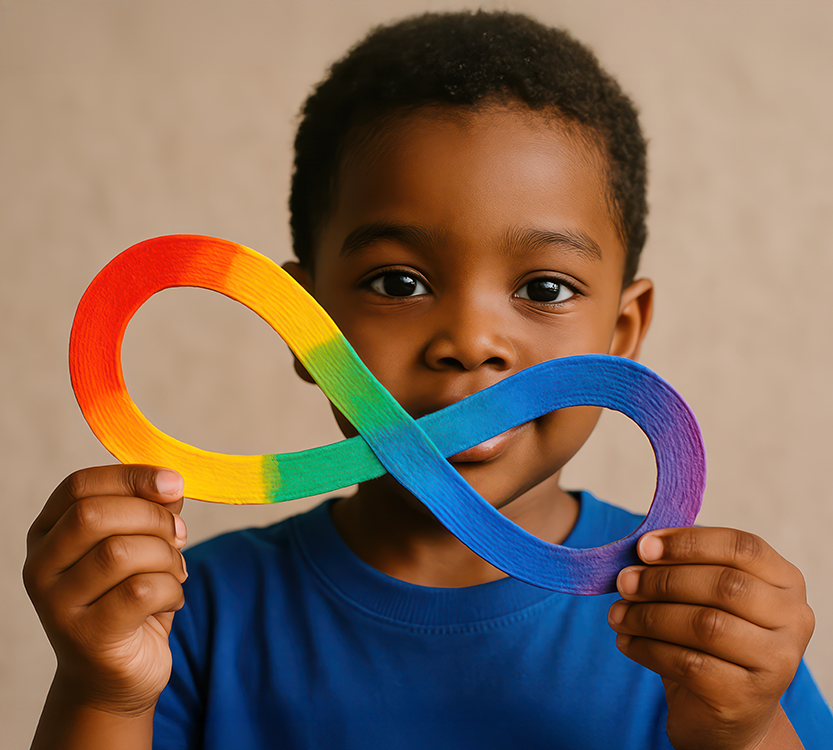
Rainbow Infinity Symbol

The rainbow infinity symbol is frequently used to represent the wide range of experiences across the autism spectrum. Its continuous shape reflects lifelong identity, while its colors highlight diversity and individuality.

Gold (“Au”) Imagery

Gold imagery, based on the chemical symbol “Au,” is often used in autism-related visibility efforts. Gold themes may appear in ribbons, pins, graphics, and educational materials and are commonly associated with recognition and community connection.

Spectrum-Inspired Designs

Abstract spectrum designs use gradients, flowing shapes, or geometric patterns to reflect variation and uniqueness. These visuals are often used in digital platforms and educational resources.

Heart and Community Motifs

Heart symbols and community-focused imagery are commonly used to express care, support, and connection. These designs highlight relationships and shared understanding.

There is no single official autism awareness symbol. Many organizations and families choose imagery that aligns with their values, audience, and goals.

Why Autism Symbols Matter

Symbols influence how messages are received and understood. In autism-related education and outreach, they can help promote awareness, encourage conversation, and signal support.

Autism symbols are frequently used during awareness and recognition efforts—particularly in April—across social media, schools, clinics, workplaces, and community events. When an autism awareness symbol is paired with clear explanations and meaningful actions, it can reinforce messages of respect, accessibility, and inclusion.

Symbols are most impactful when they are supported by inclusive practices and real-world efforts to support individuals with autism and their families.

Best Practices for Using Autism Symbols

Choosing autism symbols thoughtfully helps ensure they communicate the intended message clearly and respectfully.

Engage Individuals with Autism and Families

Including individuals with autism and family members in discussions about imagery provides valuable insight and helps ensure materials are relevant and respectful.

Clarify Your Purpose

Determine whether your goal is education, awareness, or community support. Your purpose should guide symbol selection and messaging.

Use Respectful, Strengths-Based Language

Symbols should be paired with language that emphasizes dignity, strengths, and access to support rather than focusing on limitations.

Design for Accessibility

Ensure materials are accessible by using high-contrast colors, readable fonts, alt text for images, captions for videos, and clear layouts.

Pair Symbols with Action

Imagery should be connected to tangible efforts such as training, accommodations, educational resources, or partnerships.

Adapt to the Setting

Different environments—schools, clinics, workplaces, and digital platforms—may require different approaches to imagery and messaging.

Using Autism Symbols in Schools, Clinics, and Workplaces

Symbols are most effective when they are part of broader efforts to support understanding and inclusion.

Schools

Schools can introduce symbols alongside age-appropriate explanations and pair them with inclusive teaching strategies, sensory-friendly options, and staff training.

Clinics

In clinical settings, autism symbols should align with respectful, family-centered care. Imagery can help create welcoming environments and support clear communication about services.

Workplaces

In workplaces, symbols can signal inclusive values when paired with flexible policies, clear communication practices, and accessibility accommodations.

Across all settings, explaining what a symbol represents and how it connects to meaningful support helps reinforce trust.

Language and Imagery: Supporting Respectful Representation

Symbols are only one part of how autism is represented. Language and visuals together shape understanding. Thoughtful wording helps ensure messages reflect dignity, autonomy, and respect.

  • Center lived experience by including perspectives from individuals with autism
  • Be specific when describing supports and accommodations
  • Avoid stereotypes or fear-based narratives
  • Invite ongoing feedback from families and the autism community

Frequently Asked Questions About Autism Symbols

Is there one official autism awareness symbol?
No. Multiple symbols are used today, and choice often depends on audience, setting, and purpose.

Why do different organizations use different symbols?
Symbol selection reflects organizational values, goals, and the communities being served.

What colors are commonly used in autism symbols?
Rainbow palettes emphasize diversity, gold imagery is commonly used in awareness efforts, and high-contrast designs support accessibility.

Can symbols be combined?
Yes. Combining design elements can help personalize materials while remaining inclusive and clear.

How can symbols support inclusion beyond awareness?
When paired with education, accessibility, and supportive practices, symbols help promote understanding and meaningful inclusion.

Key Takeaways

  • Autism symbol history reflects evolving understanding, advocacy, and community perspectives
  • Multiple autism symbols are used today, each with historical and contextual significance
  • Symbols are most effective when paired with respectful language and authentic support
  • Accessibility and community input should guide imagery choices
  • True inclusion is reflected in action, not just visibility

By choosing autism symbols thoughtfully, society can communicate dignity, belonging, and meaningful support for individuals with autism and their families.

Looking for support that goes beyond awareness? At LEARN, we believe inclusion is reflected in the care, partnership, and progress we build with families every day. Learn more about our compassionate autism care and how we support children and families across our communities by visiting our website.

Living a Full Life with Autism with Martin Slyngstad

Martin Slyngstad a Behavior Specialist, and currently in school to become a Speech Pathologist, joins us to discuss his multitude of interests and accomplishments as a young autistic adult.  Martin is the author of Chatter Box: My Life with Autism A Mother and Sons Perspective, founder Spire Autism, and Special Olympics gold medal winner. Martin’s warmth and sincerity are contagious as he shares his passionate belief that everyone should celebrate their authentic life.

For more information:

www.spireautism.com

www.youtube.com/@martinsautismjourney7397

All Autism Talk is sponsored by Learn Behavioral (www.Learnbehavioral.com).

Addressing Aggressive Behaviors in Children

Aggressive behavior is something that parents of children with autism or emotional disabilities are often confronted with on a regular basis. It can be a challenging, frustrating and emotionally draining experience. Through the support of a professional behavior analyst and consistent practices, parents, teachers, and caregivers can address aggressive behaviors in children and adolescents so that they can live productive and independent lives.

Many times when caregivers are faced with aggressive behavior, their impulse is to want to stop the behavior, and they may view the child as misbehaving. However, it’s important to understand that aggressive behavior is sending us a message. Every behavior serves a function— such as making a request, avoiding something, escaping a task or seeking attention. The same is true of aggression. For individuals with limited communication skills, aggressive behaviors can become inadvertently shaped by caretakers and others in their environment.

For example, a child throws a tantrum to gain access to candy. The parent gives the child candy to stop the tantrum. If this interaction repeats itself, the behaviors become reinforced and the child learns that tantruming is rewarded with access to the desired food. Next time, the parent may decide they are not going to give the child candy and so the child tantrums even louder and harder. If the parent gives the child candy, the parent has inadvertently reinforced the behavior. As parents, we all do this in very subtle ways regardless of whether our child has special needs or not, often without realizing that we are shaping our children’s behavior and strengthening the behaviors that are unwanted.

When children are small, it can be less of an issue for parents to manage aggression, or they may think that their child will grow out of it. It is easier to restrain young kids to combat and control outbursts, but if these are the only methods we use, we are not setting our teenagers up for success. It is important to understand why our kids are acting out and what they are trying to communicate. Once we know the “what” and the “why”, we can teach more appropriate means of communication to replace the need for aggression (such as making a verbal request and teaching the child to tolerate “no” when the answer is “no”). If the aggressive behaviors are not replaced by more appropriate functional behaviors, then we run the risk of shaping adolescent aggression which can include physical violence that is more serious and tougher to overcome.

If your child is demonstrating aggression, the best place to start is an assessment of his behavior to understand why the behaviors are occurring. A good assessment will tell you what the function of the behavior is, meaning— why he is acting out and what he is trying to communicate. Then a plan can be put in place to teach new methods for communicating effectively as well as reducing and eliminating the aggression using behavioral strategies.

Here are a few strategies you can use before aggressive episodes start:

  1. Give up some control over the environment or routines by offering choices; it does not matter if he brushes his teeth before changing clothes, but if having control over that routine helps keep your child’s aggression down, give up that control and let him choose. Providing choice also teaches independent thinking and problem solving which are critical skills for adult life.
  2. Prime your child by giving them a verbal “heads up” of what is coming: describe to your child when and what the expectations are for that setting.
  3. Use visual support like a picture board or a photo to help provide clear expectations for each activity or different parts of the day.
  4. Prompt and model the behavior you want to see instead of the aggressive behavior.
  5. Praise that behavior when you do see it so that it will continue to be a part of their repertoire. Remember if you like something you need to let your child know. In other words, catch them being good and if you like a behavior, reinforce it!

In the moment of the aggressive behavior, safety is most important! Do your best to keep yourself and your child safe. If you can redirect your child onto something else or an activity, that might be necessary.

Some parents of adolescents who display aggressive behaviors worry that it is too late for their child to have a fulfilling and independent life. On the contrary, it is never too late to start planning on a future for your child and working towards attainable goals. Think about what you want your child to be doing in a year from now and start working towards that today. If you want your child to ask for the desired item or preferred activity instead of tantruming to get it, start taking small steps now. If you are hoping they will have more friends in a year, start exposing your child to those opportunities and teaching the socially appropriate skills that will afford those opportunities. If you want them to have fewer aggressive behaviors, do not wait a year to start working to improve that behavior. It is never too late or too early to start working towards next year. The results will support your child in having their needs met and experiencing greater success at each stage of development. The ultimate goal is setting your child up for success and helping him achieve as much independence as possible.

-Richie Ploesch, M.A., BCBA, and Ronit Molko, Ph.D., BCBA-D

Successful Toilet Training for Kids with Autism

Potty training, toilet training, toileting… whichever term you use, tackling these skills can be a big deal for kids and their parents. Children with autism spectrum disorder (ASD) are often delayed at the age of successful toilet training, even when compared to children with other developmental disabilities. The average age in which a child is successfully toileting was 3.3 years of age for children with autism in comparison to 2.5 years of age for children with other developmental disabilities (Williams, Oliver, Allard, & Sears, 2003).

Extended use of diapers may diminish personal hygiene, self-confidence and increase physical discomfort, stigmatism, risk of problems later with bladder control and restrict participation in social activities (e.g., camp, after school program, etc.). Extended diaper use for children with autism is also problematic because these children may become so accustomed to using a diaper that they often demonstrate resistance to toilet-training procedures and will prefer to wait for a diaper in order to void (Tarbox, Williams, & Friman, 2004). Teaching independent toilet skill can improve the quality of life for children with autism and their families. Families will definitely benefit from the decreased costs of purchasing diapers, their children will feel empowered to address their physical needs independently all while decreasing the risk of complications associated with extended diaper use.

Before beginning toilet-training procedures, caregivers should check with their child’s doctors to rule out any medical conditions that may prevent their child from being successful with a toilet training program. Upon getting medical clearance, the next step will be to determine whether their child is showing signs that they are ready for toilet training. The following questions will assist with this step:

  1. Does the child act differently or seem to notice when diapers or clothing are wet or soiled?
  2. Does the child show any interest in behavior related to the bathroom, toilet, hand washing, dressing, undressing or related tasks?
  3. Does the child show an interest in seeing other people involved in activities or with objects related to toilet training?
  4. Does the child stay dry for at least 2 hours during the day or does his/her diaper stay dry after naps?

Each child and family is unique; therefore, the toilet training procedure needs to be designed to specifically fit the child and his/her family’s needs. Generally, caregivers and their clinician should identify and agree upon the child’s preferred mode of communication to best indicate when they need to use the restroom. This can be a specific word or phrase (e.g., “Potty”, “I need to use the toilet”, etc.) or it can be as simple as a hand signal or the presentation of an image of a toilet. To increase the potential for success, caregivers should have a preferred item or activity available (e.g. special snacks, video, etc.) and present it as a reward the moment that their child successfully voids in the toilet.  This item should be reserved only for toilet training. The child should also receive lots of praise and high fives when he/she stay dry for a specific duration of time.

Going from using a diaper to using a toilet can be a big change and is extremely difficult for lots of children. If your child has a hard time with transitions, a picture schedule may be a helpful tool to remind him/her of what task are needed to complete the toileting routine. Some things to remember: make sure to have plenty of extra underwear and clothes, a comfortable potty chair, a timer, your child’s favorite drinks, and a positive attitude!

Toilet training may be a lengthy process and require a lot of patience. This is a big commitment but the payoff will be huge!  Make sure to consult with your behavior analyst along the way to ensure the procedure is clear and is tailored to your child and family needs.

Dai Doan, M.S., BCBA


References

William, G., Oliver, J. M., Allard, A., & Sears, L.  (2003).  Autism and associated medical and familial factors:  A case control study.  Journal of Developmental and Physical Disabilities, 15, 335-349.

Tarbox, R. S. E., Williams, W. L., & Friman, P. C. (2004). Extended diaper wearing: Effects on continence in and out of the diaper. Journal of Applied Behavior Analysis, 37, 97-100.

How to Select Appropriate Gifts for Kids with Special Needs

Buying the perfect gift for kids and other loved ones can be challenging, and this can also be true when buying gifts for kids with autism. To help make your gift-giving easier, here are a few helpful tips to keep in mind when purchasing gifts for individuals with autism:


Focus on the person’s interests and preferences

Research shows that incorporating preferences into the learning and play environment of individuals with autism, can reduce behaviors and can increase certain skills (1). So we can capitalize on what someone already likes! For example, if a child likes dogs, find games, activities, or toys that are dog-related. If a child likes swimming, activities involving water play may be a hit (e.g., water tables, sprinkler toys, water beads, grow capsules). Alternatively, if a child is sensitive to loud noises, a toy fire truck with a siren may not be appropriate. Ask friends and family of the person for whom you are buying the gift what that person generally likes and/or dislikes.


Focus on age-appropriateness

Although keeping a person’s preferences in mind when shopping for gifts is a great start, always consider the age-appropriateness of the gift in mind. For instance, a teen with autism may love playing with shape sorters, but considering that he is a teen and the toy is meant for toddlers, there are more appropriate toys with which he could play. Try finding gifts that have similarities to the original toy, but have age recommendations that correspond to the age of the individual for whom you are buying the gift. For example, rather than buying a new shape sorter for the teen, a more appropriate gift might be Jenga or a piggy bank. In Jenga, stacking wooden blocks in a pattern and pushing wooden blocks out of a block tower is a similar activity to pushing shapes through a shape sorter. Additionally, dropping coins into a piggy bank slot is a similar activity to pushing shapes through a shape sorter. Both of the aforementioned activities could serve as a more appropriate replacement for the shape sorter.


Focus on developmental-appropriateness

Many toys come with age recommendations, and while these recommendations are helpful, they might not always lead you to the perfect gift. A rule of thumb when purchasing a gift is to consider both the age and the development of the person for whom you are buying a gift. For example, the game “Apples to Apples” would not be developmentally appropriate for a non-verbal teen, even if it is an age-appropriate game. When looking for the right gift, focus on what the person can do. For instance, if the non-verbal teen mentioned above is great at drawing, then a sketch pad or an adult coloring book could be a more appropriate gift. If you are unsure what the person can do, ask friends and family of the person for whom you are buying the gift what skills that person has mastered.

Note: Be sensitive to how family and friends of a person with autism may feel when being asked questions about the skills of their loved one. If asking questions, always frame your questions from the perspective of accomplishment (e.g., what skills have they mastered) and not deficit (e.g., in what areas are they delayed) to be supportive and respectful of the individual’s growth and development.


Be mindful of behavior excesses/triggers

Some individuals with autism engage in behaviors that put them or their loved ones at risk of harm. For example, if a child engages in pica (e.g., eating of nonfood items), gifts containing small objects may pose as a choking hazard. For example, if a child engages in aggression towards others, gifts with violent content may not be appropriate, as additional exposure to violence may contribute to future instances of aggression. Alternatively, individuals with sensory-seeking behaviors may benefit from gifts that redirect their behaviors in more appropriate ways. For example, if a child rocks back and forth, a swing may be a great way to meet their sensory need. Additionally, certain objects can trigger behaviors in some individuals with autism (e.g., loud noises, highly preferred items, phobias, etc.). Ask friends and family of the person for whom you are buying the gift if there are any behavior excesses/triggers to consider before purchasing a gift.


Focus on toys that encourage interaction with others

Social deficits are a defining characteristic of autism, which means that when gift-giving, try to purchase gifts that encourage social interaction. While almost any activity can be turned into a social interaction, certain activities may be more conducive to social interactions than others. For example, instead of buying a computer game, consider the game Bop It, which is an electronic game that can be played in a group.


Focus on expanding their repertoire

Individuals with autism sometimes have restricted or limited interests (e.g., a person only wants to talk about trucks or only wants to play with dinosaurs). In order to help expand their repertoire, try finding activities that are new, but similar to current interests. For example, if a child’s favorite activity is playing with PlayDoh, kinetic sand or slime may be an appropriate gift to help expand their repertoire because it is similar to their current interest, but slightly different. Ultimately, gifts that will provide them with new experiences may act as potential new reinforcers (e.g., stimuli that increase behaviors), and may significantly enrich their learning environment.


Recommendations

Stores: Lakeshore Learning Center, Autism-Products.com, NationalAutismResources.com, Target, Kohl’s, Amazon, WalMart, iTunes (for apps)

Brands: Melissa and Doug, Fat Brain Toys

Apps: Proloquo2Go, Avaz Pro, Life360 (Find my family, friends, phone), Choiceworks


– Brittany Barger, M.Ed., BCBA


Resources

Increasing Task Engagement Using Preference or Choice-Making
Some Behavioral and Methodological Factors Affecting Their Efficacy as Classroom Interventions

Preparing for Holiday Meals

The holidays are quickly approaching, which means family, festivities, and food! While the holidays can be fun for the whole family, they can also be a stressful time for children on the autism spectrum due to the changes in typical routines and settings. Holiday meals with extended family can present issues for a child with autism, including trying new foods, sitting among loud family members, and being in an unfamiliar location. Here are some helpful tips to make the holiday experience more enjoyable for the whole family.

Prepare your child for the event.
Use photos, a social story, or show them a video, modeling what will be expected of them. Will they need to sit at a communal table surrounded by family? Will they be expected to try new foods? How about preparing your child for the family members who will be present? You can practice with role play at home with real or fake food so your child is familiar with the expectation of the meal. To make it easier this time of year, you can also bring some favorite foods along that you know will be successful.

Support them during the event.
Bring activities and toys so your child has something to do while waiting for the meal to begin. If your child is very picky with food, bring some preferred alternatives that they will eat so they don’t become agitated while waiting and to remind your child of familiar food routines.

Give them a chance to escape if they need it.
If your child becomes overstimulated by loud noises or holiday lights and decorations, find a quiet place in the home for them to decompress and take a break. Your child can rejoin the family once he or she feels comfortable doing so.

While holiday meals can be stressful, hopefully these tips will help keep everyone’s spirits bright!


– Sarah Low, M.A., BCBA